


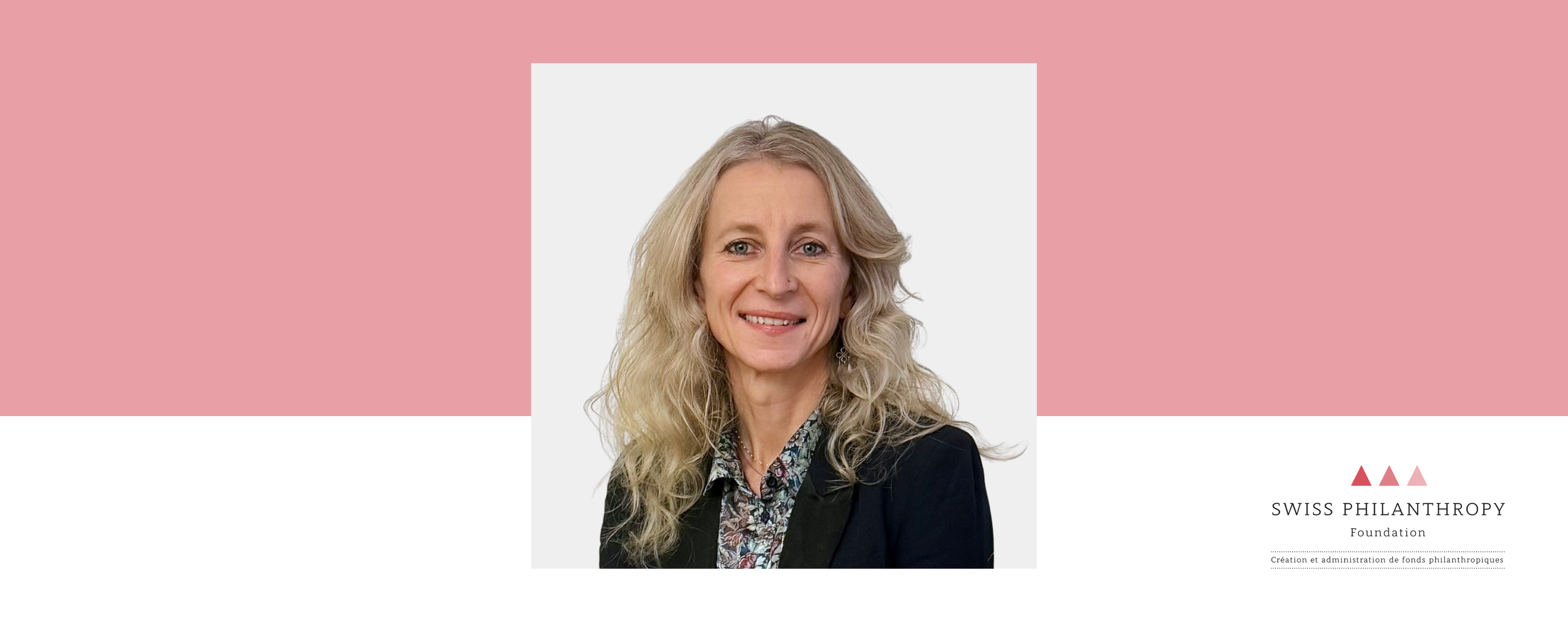
The Foundation is opening a new chapter with the arrival of Alexandra Bilak as Director General. With nearly 25 years of experience in the non-profit sector and 15 years in leadership roles, she brings a deep understanding of the transformations shaping philanthropy today. Here, Alexandra Bilak shares a few reflections on her journey and her priorities for the years ahead.
How did your career path lead you to SPF?
My professional journey has been shaped by nearly twenty-five years working with international NGOs, mainly in sub-Saharan Africa. I have held operational roles on issues related to sustainable development, conflict management, support for displaced populations, and climate change adaptation.
I was quickly entrusted with significant responsibilities in team and programme management. As early as 2006, for example, I held leadership positions in the Democratic Republic of the Congo, in a particularly demanding context marked by war and instability. This formative experience profoundly influenced my approach to leadership, teaching me humility, adaptability, and the importance of decision-making in uncertain circumstances.
Over the years, my career has led me to work in highly diverse environments, on topics ranging from humanitarian action to research and advocacy, as well as partnership development and organisational transformation. I have had the privilege of collaborating with multicultural and multidisciplinary teams that broadened my worldview and helped me shape a management approach grounded in human dynamics, attentive listening, and co-creation.
What personally motivates you in this role?
What deeply motivates me is SPF’s unique nature: a strong and confident institution that nevertheless remains in constant motion and continuous evolution. As it celebrates its twentieth anniversary this year, the foundation finds itself at a stage comparable to that of a young adult: it has established its identity and built solid foundations, yet it still retains the energy and ambition that open up many opportunities for learning and innovation.
I have always been drawn to organisations that are willing to challenge themselves and approach transformation with lucidity and integrity. SPF embodies that mindset.
As head of the foundation, I want to embrace this diversity and this momentum for change, while also bringing balance, stability, and strategic continuity. My role is to enable collective energy to fully express itself within a clear and demanding framework. Throughout my professional and personal journey, I have learned to combine boldness with discernment, movement with grounding. This is the posture I wish to embody: that of a committed, responsible leadership resolutely focused on the future.
How would you describe the foundation’s main strengths today?
Even with the perspective of someone still relatively new to the organisation, I am struck by the deeply entrepreneurial and visionary spirit that characterises SPF. The foundation stands out for its ability to identify and seize strategic opportunities as they arise, which has enabled it to quickly position itself as a credible and innovative player within the philanthropic ecosystem.
Another major strength lies in the strong anchoring of the foundation’s values. These are reflected concretely in strategic choices, in the quality of its relationships with partners, and in its internal culture.
This dynamic is driven by a very committed and agile team, as well as by a highly engaged board that shares a clear vision of the role SPF can play.
What ambition would you like to pursue for the foundation?
In the years ahead, my ambition is to support SPF through a phase of consolidation and growth, transforming recent successes into lasting achievements and long-term drivers of change.
One priority is to further deepen the quality of the service we provide. Beyond acting as a facilitator or technical service provider, SPF aims to become a true strategic partner, capable of supporting donors in structuring and implementing their philanthropic ambitions.
Lastly, I would like to help position SPF as a key player and a source of inspiration within the philanthropic ecosystem, both in Switzerland and internationally. This means actively contributing to discussions about the future of philanthropy, the new forms of cross-sector collaboration that are emerging, and the innovative responses needed to address today’s societal challenges.

 Previous