


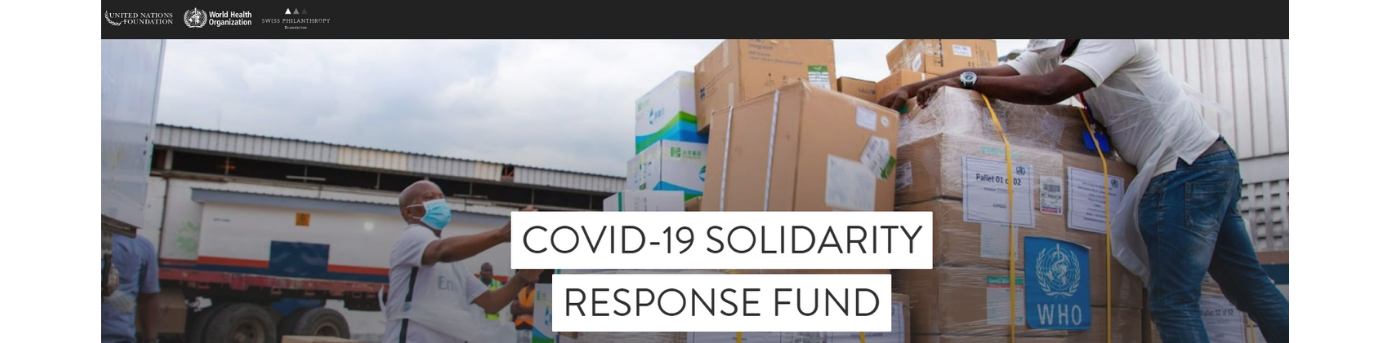
Closing of the COVID-19 Solidarity Response Fund after nearly two years of collaboration with Swiss Philanthropy Foundation
In response to the COVID-19 pandemic, the World Health Organization (WHO) launched the COVID-19 Solidarity Response Fund on March 13, 2020, the first and only pooled fund for individuals, corporations, and foundations to support the work of WHO and its partners to help countries prevent, detect, and respond to the COVID-19 pandemic, particularly where the need was greatest. The money raised through the Fund was able to be disbursed quickly and flexibly, so that it got to where it was needed most, as quickly as possible.
At WHO’s request, this Solidarity Response Fund was co-hosted by the United Nations Foundation and Swiss Philanthropy Foundation from March 13, 2020 to March 13, 2021.
Our mission was to collect donations in Switzerland and Europe, which were then used by WHO and its partners to assist countries according to the WHO COVID-19 Strategic Preparedness and Response Plan, which outlines global public health strategies to combat the COVID-19 pandemic.
Our European partners in the Transnational Giving Europe network and KBF Canada were involved and helped collect donations from European and Canadian donors.
On March 13, 2021, the Geneva-based WHO Foundation took over the fund’s activities, becoming the lead agent for the COVID-19 Solidarity Response Fund.
Between March 2020 and December 2021, 676,626 donors (individuals, corporations, foundations) participated in the global effort and over $256 million was raised. In Europe, $32 million has been raised through Swiss Philanthropy Foundation.
On December 31, 2021, the COVID-19 Solidarity Response Fund was officially closed by the WHO.
Swiss Philanthropy Foundation is honored to have been able to participate in this collective effort at the request of WHO and in collaboration with the United Nations Foundation, by facilitating donations from Switzerland, Europe and Canada to the COVID-19 Solidarity Response Fund with its partners. In total, the Swiss Philanthropy Foundation received CHF 32.3 million from 3’850 donors. We are very grateful to WHO and the United Nations Foundation for their confidence in this collaboration.
The Joint Evaluation Report of the WHO Evaluation Office and the United Nations Foundation
In the context of the closure of the COVID-19 Solidarity Response Fund, the WHO Evaluation Office and the United Nations Foundation commissioned and co-led an evaluation of the Fund’s performance.
The overarching objective of this formative evaluation, designed to strengthen accountability and learning, was to assess the architecture, functioning and results of the COVID-19 Solidarity Response Fund.
It documented key achievements, best practices, challenges, gaps and areas for improvement in the set-up and administration of the Fund; assessed key factors responsible for achievements and areas for improvement; identified key lessons of use for the WHO Foundation and for future similar mechanisms; and made recommendations for WHO, the United Nations Foundation (UNF), and partners to consider.
The evaluation found that the Fund has been very successful in positioning itself in a timely and effective manner to respond to the COVID-19 pandemic. The Fund’s network of funding partners, including Swiss Philanthropy Foundation, has been a key element in the scale, success, and effectiveness of the Fund’s work.
In particular, the evaluation found that the COVID-19 Solidarity Response Fund was A) ) highly relevant in responding to the needs at hand in the response to COVID-19, primarily evidenced by its alignment to the WHO Strategic Preparedness and Response Plan (SPRP) for COVID-19; B) highly effective in terms of the Fund’s overall resource mobilization, and effective in delivery against its Key Performance Indicators, with evidence of effective contribution to the achievements in each of the three SPRP pillars; and C) highly efficient in terms of its management and function. Its set-up and implementation were enacted with speed, purpose and diligence. WHO, UNF and Swiss Philanthropy Foundation, as primary fiduciary partners, leveraged their respective operational capacity and readiness, pre-existing strategic partnerships, trusted working relationships and adopted a ‘minimal regrets’ approach to balance the speed needed for an emergency fund with sufficient attention to due diligence and fiduciary considerations.
Evaluation report to download here
Evaluation Summary to download here
« Your contribution has been of utmost importance and critical in the creation and management of this novel instrument. (…) The Solidarity Reponse Fund has been a critical source of funding for WHO’s overall response. It has allowed us to impact people’s live, reach the most vulnerable groups, work with civil society organizations, engage youth, advance research, strengthen health systems, encourage vaccine uptake, among key achievements. None of this would have been possible without your support »
Dr. Tedros Adhanom Ghebreyesus to Swiss Philanthropy Foundation
Impact: How are donations used?
Donations to the COVID-19 Solidarity Response Fund support the World Health Organization‘s (WHO) unique and essential role in coordinating, supporting and procuring global public goods. They are used by the WHO and its partners to assist and support countries according to the COVID-19 Strategic Preparedness.
The WHO called on UNICEF, the “Coalition for Epidemic Preparedness Innovations” (CEPI), the “United Nations World Food Programme” (WFP), the “Office of the United Nations High Commissioner for Refugees” (UNHCR), and the “United Nations Relief and Works Agency for Palestine Refugees in the Near East” (UNRWA) to be partners of the Fund. Recognizing their essential role in achieving the goals of the Plan, to accelerate vaccine research and development, and to reach and support the most vulnerable communities in low-resource countries. Under the leadership of the WHO, the financial resources collected are thus allocated to the areas of greatest need and directly to the above mentioned organizations.
Impact Report
The World Health Organization regularly publishes impact reports to publicly inform on the use of fund resources and efforts by the WHO and its partners to respond to the COVID-19 pandemic, according to the COVID-19 Strategic Preparedness and Response Plan updated version for 2021-2022. Below are the latest reports:
In addition, a progress report on the COVID-19 Strategic Preparedness and Response Plan is also available [1st February 2020 –30th June 2020] : download here.
WHO’s response to COVID-19 – 2021 Annual Report is available to download here.
COVID-19 Solidarity Respond Fund Donors for the WHO
We are extremely grateful for the commitment and support of every donor in this fight against COVID-19. Alongside individuals and foundations, companies are getting involved. Discover the institutional donors in Switzerland and Europe, who generously contributed in 2020 up to CHF 100’000 and more via Swiss Philanthropy Foundation.
Find all the international institutional donors who have contributed to the COVID-19 Solidarity Response Fund on the dedicated page.
Learn More
To learn more about the history and impact of the COVID-19 Solidarity Response Fund from 13.03.2020 to 31.12.2021, visit the COVID-19 Solidarity Response Fund impact page.
Although this specific fund has been closed as of December 31, 2021, WHO continues its fight against COVID-19 and the WHO Foundation continues to raise funds for various projects related to the fight against COVID-19. Those wishing to make a donation can do so on the following account:
Account holder: Foundation in Support of the World Health Organization (WHO)
Address: Chemin des Mines 2, 1202 Geneva, Switzerland
Bank: Credit Suisse SA, Rue du Lion-d’Or 5-7, 1003 Lausanne, Switzerland
BIC/SWIFT: CRESCHZZ80A
IBAN:
EURO account: CH06 0483 5229 8768 1200 6
USD account : CH76 0483 5229 8768 1200 7
CHF account: CH08 0483 5229 8768 1100 1
Read the WHO Foundation FAQ about the closure of the Fund
Read WHO Foundation CEO Anil Soni’s letter about the transparency of the Foundation